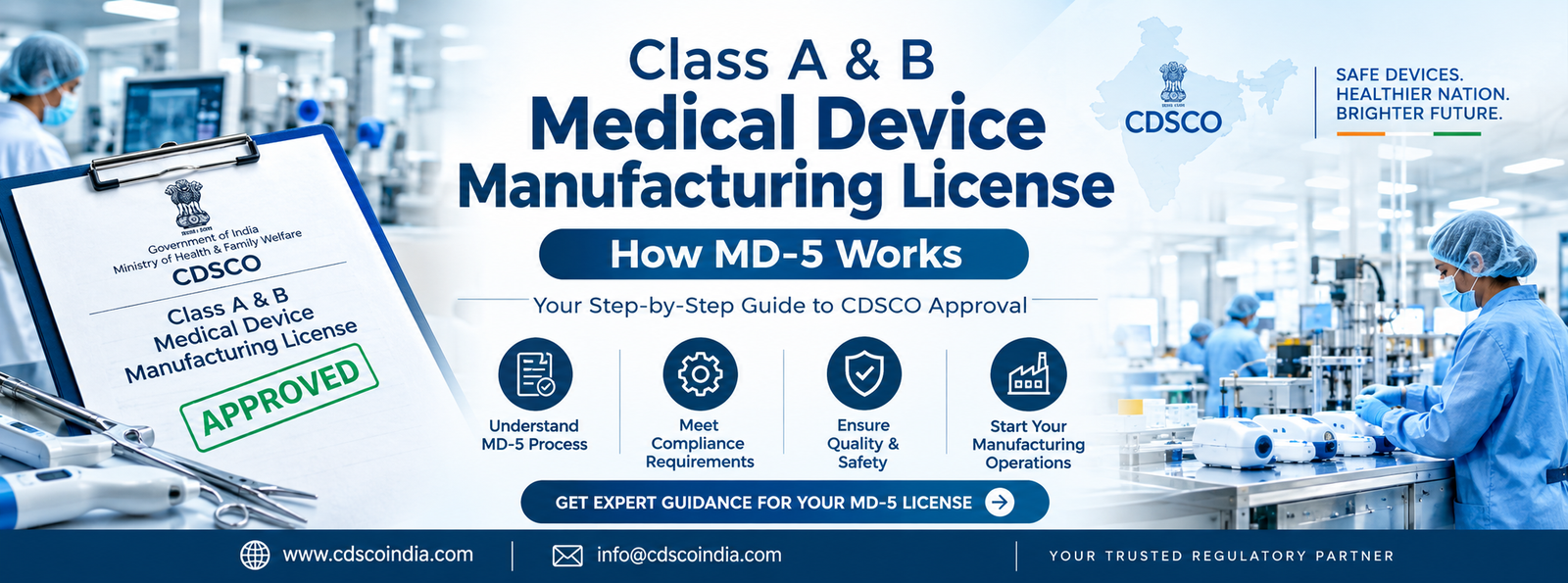
Medical device manufacturers in India must follow the applicable requirements under the Medical Devices Rules, 2017 before manufacturing regulated devices for sale or distribution. The Class A & B Medical Device Manufacturing License pathway uses Form MD-3 for the application and Form MD-5 for the licence, subject to the device classification and applicable regulatory requirements.
The first step is to confirm whether the device actually falls within the licensing pathway. Class A devices are generally low risk, while Class B devices are low to moderate risk. Importantly, Class A non-sterile and non-measuring devices are exempt from the licensing requirement under the applicable notification, so not every Class A device needs an MD-5 licence.
Class A & B Medical Device Manufacturing License: What Is It?
The Class A & B Medical Device Manufacturing License is the manufacturing licence issued for eligible Class A and Class B medical devices intended for sale or distribution in India. The manufacturer applies in Form MD-3, and the State Licensing Authority grants the licence in Form MD-5 after the prescribed requirements are satisfied.
The licence is linked to the approved manufacturing activity and the devices covered by the regulatory application. Manufacturers therefore need to keep their product details, manufacturing site, quality systems and supporting documents consistent throughout the application.
Class A & B Medical Device Manufacturing License: Who Needs It?
The Class A & B Medical Device Manufacturing License can be relevant for Indian manufacturers producing eligible medical devices in India for sale or distribution. It may also apply when an existing manufacturer adds regulated Class A or Class B products to its manufacturing scope.
Before applying, the manufacturer should confirm the product classification, intended use, manufacturing process, facility readiness, and applicable quality requirements. A wrong classification can lead to an incorrect application route or additional regulatory queries.
Which Devices Fall Under Class A and Class B?
India follows a risk-based medical device classification system. CDSCO describes Class A as low-risk devices, Class B as low-moderate-risk devices, Class C as moderate-high-risk devices, and Class D as high-risk devices.
For Class A, the exemption applicable to non-sterile and non-measuring devices is important. A manufacturer should check the latest notification and the exact characteristics of the device before deciding whether a Class A & B Medical Device Manufacturing License is required.
You can also review the related Medical Device Risk Classification service to understand how classification connects with the licensing route.
MD-3 and MD-5: What Is the Difference?
A common point of confusion is the difference between MD-3 and MD-5.
- Form MD-3 is the application for the applicable Class A or Class B manufacturing licence.
- Form MD-5 is the manufacturing licence granted by the State Licensing Authority after the applicable requirements are met.
- Form MD-4 is used for a loan licence application, while Form MD-6 is the corresponding loan licence.
So, the Class A & B Medical Device Manufacturing License refers to the MD-5 licence itself, not the application form.
Class A & B Medical Device Manufacturing License Documents Required
The documents for a Class A & B Medical Device Manufacturing License depend on the product, manufacturing facility, and applicable regulatory requirements. Typical information can include:
- Company or constitution documents
- Applicant and authorised-person details
- Manufacturing site and facility details
- Plant and site information
- Manufacturing process details
- Equipment and machinery information
- Quality management documents
- Device description and intended use
- Product specifications
- Risk classification information
- Labelling and packaging information
- Testing and validation records, where applicable
- Risk management and technical documentation
- Other documents prescribed under the Medical Devices Rules
The Medical Devices Rules require the application to be supported by the applicable documents under the Fourth Schedule and an undertaking concerning compliance with the Quality Management System requirements under the Fifth Schedule.
Quality Management System Requirements
Quality management is a major part of the Class A & B Medical Device Manufacturing License process. The manufacturer must meet the applicable Quality Management System requirements under the Medical Devices Rules.
Depending on the device and manufacturing activity, the quality system may include document control, production controls, inspection and testing, equipment management, process validation, risk management, complaint handling, corrective and preventive action, and record maintenance.
The exact compliance package should be matched to the product and applicable regulatory provisions rather than relying on a generic checklist.
How to Apply for an MD-5 Manufacturing License
The Class A & B Medical Device Manufacturing License process can be understood in a few practical steps:
Step 1: Classify the medical device
Confirm whether the device is Class A or Class B using the applicable risk-classification rules and product characteristics.
Step 2: Review the regulatory pathway
Check whether the product is subject to MD-5 licensing or covered by an applicable exemption, particularly for Class A non-sterile and non-measuring devices.
Step 3: Prepare the documents
Compile company, site, technical, quality, product, labelling, and other required documents.
Step 4: Prepare Form MD-3
Complete the MD-3 application with consistent product and manufacturing information.
Step 5: Submit the application
File the application through the applicable government online system with the prescribed fee and supporting documents.
Step 6: Regulatory review and audit
The State Licensing Authority reviews the application. For Class B devices, the manufacturing site is audited by a registered Notified Body before the licence is granted. For applicable Class A devices, the Rules provide for the required audit after grant of the licence within the specified period.
Step 7: Grant of MD-5
Once the applicable requirements are satisfied, the State Licensing Authority may grant the licence in Form MD-5.
For comparison, Class C and Class D manufacturers follow a different pathway through MD-7 and MD-9. See the MD-7 Manufacturing License service for the higher-risk device route.
MD-5 Timeline for Class A and Class B
The regulatory timeline differs between Class A and Class B applications.
For eligible Class A applications, the State Licensing Authority is required to grant or reject the application, with reasons recorded, within 45 days from the date of application, subject to fulfilment of the prescribed requirements. For applicable Class A devices, the required manufacturing-site audit is to be conducted by a registered Notified Body within 120 days from the date the licence is granted.
For Class B applications, the rules provide for the Notified Body audit within 90 days from the date of application, submission of the audit report to the State Licensing Authority within 30 days of completion, and grant or rejection by the authority within 20 days of receiving the audit report, subject to fulfilment of the requirements.
Actual project timelines can still vary because document completeness, regulatory queries and compliance issues can affect the overall process.
Government Fee for MD-5
The government fee for the Class A & B Medical Device Manufacturing License is prescribed under the Second Schedule of the Medical Devices Rules, 2017.
The applicable fee should be checked against the current regulatory schedule before filing because fee provisions and notifications can change.
MD-5 vs MD-7 Manufacturing License
Manufacturers often confuse MD-5 with MD-7.
MD-5 is the manufacturing licence pathway for eligible Class A and Class B medical devices, while MD-7 is the application form for manufacturing Class C and Class D devices. Class C and Class D manufacturing licences are issued through the central licensing pathway in Form MD-9.
This distinction matters because the risk class determines the licensing route and the regulatory authority involved.
MD-5 vs MD-6 Loan License
The Class A & B Medical Device Manufacturing License under MD-5 should also be distinguished from MD-6.
MD-5 is the regular manufacturing licence, whereas MD-6 is a loan licence for the applicable Class A and Class B manufacturing pathway. The application for a loan licence is made in Form MD-4.
A manufacturer should select the correct route based on how the manufacturing activity and facility arrangement are structured.
Common Mistakes in MD-5 Applications
Manufacturers can face delays when the application contains inconsistent or incomplete information. Common problem areas include:
- Incorrect device classification
- Missing or outdated documents
- Inconsistent company or manufacturing-site details
- Incomplete technical documentation
- Gaps in quality procedures
- Inadequate product specifications
- Errors in labelling information
- Failure to address regulatory queries properly
- Applying for MD-5 when an exemption or another licence pathway applies
- Not preparing the facility for applicable audit requirements
A document review before submission can reduce avoidable queries and help the application move through the process more smoothly
2026 Regulatory Update
The regulatory framework continues to evolve. In August 2026, CDSCO published amendments to the Medical Devices Rules, 2017 concerning EU countries under Rule 63 and Quality Management System requirements for Class A non-sterile and non-measuring devices. A separate August 2026 amendment introduced the Ninth Schedule and labelling requirements related to sterilization activities.
Manufacturers should therefore verify the latest CDSCO notifications before filing or updating an application, particularly where product classification, QMS obligations, labelling or post-approval compliance may be affected.
How ELT Corporate Helps With MD-5
ELT Corporate can support manufacturers through the Class A & B Medical Device Manufacturing License process from the initial assessment to regulatory coordination.
The support can include:
- Product and risk-classification assessment
- Review of the applicable licence pathway
- MD-3 application preparation
- Regulatory document checklist
- Technical and quality documentation support
- Manufacturing-site compliance guidance
- Preparation for applicable Notified Body audit requirements
- Online filing assistance
- Regulatory query and response support
- Post-licence compliance guidance
The objective is to make the licensing process easier to understand and more structured for manufacturers while keeping the application aligned with the applicable regulatory framework.
For manufacturers involved in later distribution activities, the related MD-42 Sales & Distribution Licence service may also be relevant.
Conclusion
The Class A & B Medical Device Manufacturing License is an important regulatory pathway for manufacturers of eligible Class A and Class B medical devices in India. The process begins with correct device classification and continues through documentation, QMS compliance, MD-3 filing, regulatory review, and, where applicable, Notified Body audit.
Because Class A exemptions and regulatory requirements can depend on the nature of the device, manufacturers should verify the current rules and notifications before filing. A well-prepared application can help reduce avoidable queries and compliance issues.
For manufacturers planning a new product, expanding their device portfolio, or setting up a medical device manufacturing facility in India, professional regulatory support can help simplify the process.
Frequently Asked Questions
MD-5 is the manufacturing licence issued for eligible Class A and Class B medical devices after the applicable requirements are satisfied.
Form MD-3 is used to apply for the applicable Class A or Class B manufacturing licence.
The State Licensing Authority issues the MD-5 manufacturing licence for eligible Class A and Class B medical devices.
No. Class A non-sterile and non-measuring devices are exempt from the licensing requirement under the applicable notification. The exact status should be checked for the particular device.
Eligible Class B medical devices are subject to the applicable manufacturing licensing requirements under the Medical Devices Rules, 2017.
For eligible applications, the rules provide specific timelines for Class A and Class B processing, but the overall project duration can vary because of document review, queries, audit requirements, and compliance responses.
For applicable Class B devices, a Notified Body audit is required before grant of the licence. For applicable Class A devices, the required audit is conducted after the licence is granted within the specified period.
Documents can include company details, manufacturing-site information, technical documentation, device information, quality documents, labelling, testing and risk-management records, depending on the product and applicable requirements.
MD-5 is the manufacturing licence for eligible Class A and Class B devices. MD-7 is the application form used for Class C and Class D manufacturing.
Yes. ELT Corporate can assist with classification, documentation, MD-3 preparation, filing, regulatory queries, audit-readiness support and post-licence compliance.