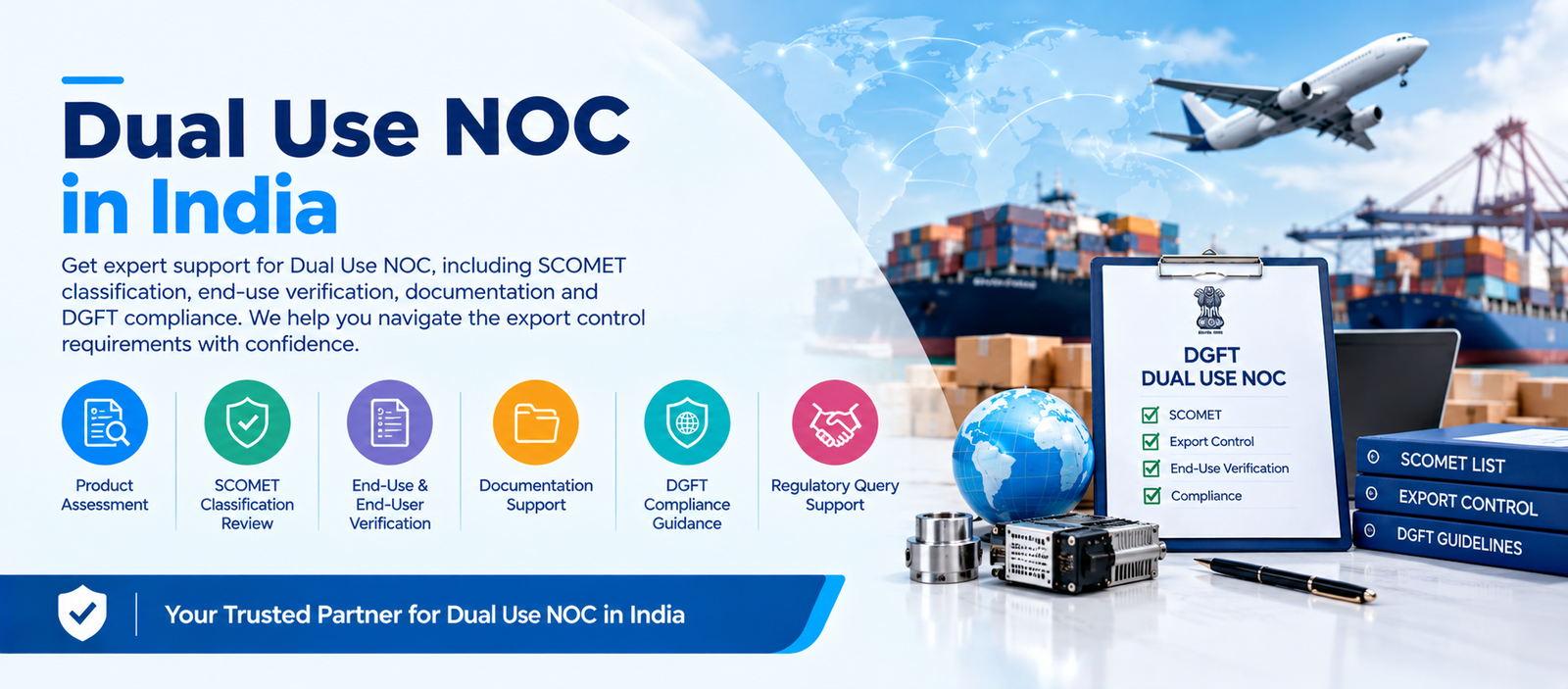
Support for Dual Use NOC and SCOMET matters — product assessment, classification review, end-use documentation, application and query support.
Dual Use NOC is an important regulatory requirement in certain cases involving products, materials, chemicals, equipment, technology or other items that may have both civilian and strategic applications. Such items may be used for legitimate commercial or industrial purposes but can also have potential military or weapons-related applications.
In India, the export of specified dual-use items is regulated through the SCOMET (Special Chemicals, Organisms, Materials, Equipment and Technologies) framework under the Foreign Trade Policy. SCOMET covers dual-use items, munitions and nuclear-related items, including software and technology.
ELT Corporate helps businesses understand the applicable export-control requirements, assess the product and end-use details, prepare supporting documentation and coordinate the regulatory process for applicable Dual Use NOC and SCOMET matters.
- AssessProduct and SCOMET classification
- DocumentEnd-use, end-user and technical papers
- AuthoriseNOC or export authorisation
Quick Facts
| Particular | Details |
|---|---|
| Control list | SCOMET, under the Foreign Trade Policy |
| Main authority | DGFT for most categories |
| Nuclear items | Certain Category 0 matters — Department of Atomic Energy |
| Covers | Goods, software and technology |
| Key document | End User Certificate, where applicable |
| Non-listed items | Catch-all controls may still apply |
| Decided by | Item, specifications, destination, end-use and end-user |
What is a Dual Use NOC?
A Dual Use NOC generally refers to a regulatory No Objection Certificate or clearance from the relevant authority where an item has potential dual-use implications and an additional regulatory clearance is required.
It is important to first determine whether the product falls under the SCOMET list, another controlled category, or a specific NOC requirement. SCOMET contains categories covering chemicals, microorganisms, materials and processing equipment, aerospace, munitions, electronics, telecommunications, information security, sensors, lasers and other strategic items.
The exact approval or authorisation required depends on the nature of the item, technical specifications, destination, end-use and applicable regulatory category.
Why is Dual Use NOC Important?
Dual-use products can be used in both civilian and strategic applications, so export controls exist to ensure controlled products and technologies are supplied for legitimate and permitted purposes. A proper regulatory assessment helps businesses:
- ClassificationIdentify whether the product is controlled under SCOMET.
- RequirementsUnderstand the applicable SCOMET obligations.
- End-Use ReviewCheck the proposed end-use, destination and end-user.
- DocumentationPrepare the required supporting documents.
- Query HandlingAddress regulatory queries during review.
- RecordsMaintain appropriate records for the transaction.
The framework also provides additional controls on certain non-SCOMET items where the exporter knows or has reason to believe the item may have potential WMD, missile-system or military end-use risks.
Who May Need Dual Use NOC Support?
- Manufacturers of controlled products
- Exporters of chemicals and materials
- Electronics and technology companies
- Aerospace companies and defence-related suppliers
- Research and technology organisations
- Biotechnology companies
- Engineering and industrial equipment manufacturers
- Traders dealing with strategic products
- Companies exporting specialised software or technology
The requirement should be assessed on the basis of the specific product and proposed transaction, rather than simply the name of the product.
SCOMET and Dual Use Items
SCOMET is India’s national export-control list for dual-use items, munitions and nuclear-related items, including software and technology. The framework divides SCOMET into categories:
| Category | Covers |
|---|---|
| Category 0 | Nuclear materials and nuclear-related items |
| Category 1 | Toxic chemicals and other chemicals |
| Category 2 | Microorganisms and toxins |
| Category 3 | Materials and materials-processing equipment |
| Category 4 | Nuclear-related equipment and technology |
| Category 5 | Aerospace systems and related equipment |
| Category 6 | Munitions |
| Category 7 | Reserved |
| Category 8 | Electronics, computers, telecom, information security, sensors, lasers |
The licensing authority varies by category — DGFT is the licensing authority for many SCOMET categories, while certain Category 0 matters fall under the Department of Atomic Energy.
Share the product specifications, destination and end-use — we will check the SCOMET position before you commit to the shipment.
Dual Use NOC Application Process
- Product assessmentUnderstand the product, technical specifications, composition, functionality and intended application.
- SCOMET classification reviewReview the product against the applicable category and control parameters.
- End-use assessmentExamine the proposed end-use, end-user and destination.
- DocumentationPrepare and review the commercial, technical and regulatory documents.
- NOC or authorisation applicationSubmit the application and supporting documents to the concerned authority.
- Regulatory query supportPrepare responses where additional information or clarification is requested.
- Approval or authorisationThe relevant NOC, approval or export authorisation may be issued, subject to the authority’s decision and conditions.
Documents Required for Dual Use NOC
The documents vary depending on the product and regulatory category. Common information includes:
- Import Export Code (IEC)
- Company incorporation details
- Purchase order or export contract
- Quantity and value of proposed export
- Importer or consignee details and destination country
- Product name and description
- Technical specifications
- Product catalogue or datasheet
- HS / ITC(HS) classification details
- Manufacturing details
- End-user details
- End-use statement
- End User Certificate, where applicable
- Relevant declarations or undertakings
- Other documents requested by the concerned authority
For SCOMET applications, the procedures provide for end-user documentation and an End User Certificate in applicable cases, including information about the item, importer, supply-chain entities and specific end-use.
End-Use and End-User Verification
End-use is an important part of dual-use export compliance. Businesses may need to demonstrate that the product will be used for the stated purpose and will not be transferred or diverted contrary to applicable conditions. Applicable End User Certificates can include commitments regarding the stated purpose, non-transfer and verification of the end-user.
Information should match across purchase orders, invoices, technical documents, end-use statements and the regulatory application.
Dual Use NOC for Non-SCOMET Items
A product does not automatically become unrestricted simply because it is not listed in SCOMET. Under the catch-all control provisions, certain non-SCOMET items can also be subject to export controls where the exporter has been notified by DGFT, or knows or has reason to believe that the item could be used in or diverted to WMD, missile-system or military applications. This makes product-level and transaction-level assessment important before export.
Common Issues in Dual Use NOC Applications
- Incorrect SCOMET classification
- Incomplete technical specifications or incorrect product description
- Missing end-user information
- Inconsistent end-use details
- Incomplete supporting documents
- Incorrect HS classification
- Missing End User Certificate where applicable
- Failure to identify catch-all controls
- Not responding properly to regulatory queries
How ELT Corporate Helps
- Product AssessmentDual-use product assessment and SCOMET applicability review.
- ClassificationProduct classification and technical document review.
- End-Use DocumentsEnd-use and end-user documentation support.
- ApplicationApplication preparation and supporting document review.
- Query SupportStructured responses when clarification is requested.
- After ApprovalExport-control documentation and post-approval guidance.
Benefits of Professional Assistance
- Understand requirements — identify the applicable export-control framework
- Improve documentation — present technical and commercial information properly
- Reduce errors — catch classification and documentation issues before submission
- Support compliance — stay aligned with applicable DGFT and SCOMET requirements
- Handle queries — structured support when additional information is requested
- Save time — fewer rounds of back-and-forth caused by incomplete applications
Frequently Asked Questions
It refers to a regulatory no-objection or clearance requirement that may apply to products having potential civilian as well as strategic or military applications. The exact requirement depends on the product and transaction.
Products, software, technology, chemicals or equipment that can have both civilian or industrial and strategic applications. Specified dual-use items are regulated through the SCOMET framework.
No. Applicability depends on the product, specifications and relevant controls. Certain non-SCOMET items can also become subject to catch-all controls.
Special Chemicals, Organisms, Materials, Equipment and Technologies — India’s national export-control list for specified dual-use items, munitions and nuclear-related goods, software and technology.
The licensing authority depends on the category. DGFT is the licensing authority for many categories, while certain nuclear-related Category 0 matters are handled by the Department of Atomic Energy.
It may be required depending on the applicable SCOMET procedure and transaction.
Yes. Certain non-SCOMET items may be controlled under catch-all provisions when specified risk conditions exist.
Product specifications, technical literature, IEC, purchase order, end-user details, end-use information, commercial documents and applicable declarations or certificates.
We assist with product assessment, SCOMET review, documentation, end-use and end-user information, application preparation and regulatory query support.
Not necessarily. It depends on the nature of the item, its classification, destination, end-use, end-user and applicable export-control provisions.
Need Dual Use NOC Support?
India’s export-control framework regulates specified dual-use items and also provides additional controls for certain non-SCOMET items under catch-all provisions. From product assessment and SCOMET classification review to documentation, end-use verification and application support, ELT Corporate provides structured assistance.
Share the product, destination and end-use, and our team will confirm the applicable pathway before you file.
Book Your ConsultationFrom documentation to final approval, our regulatory team handles the entire process for you.