
Introduction
The Indian cosmetic market offers opportunities for businesses that want to import beauty, skincare, haircare and personal care products from other countries. However, importing cosmetics into India requires businesses to follow the applicable regulatory requirements.
The CDSCO Cosmetic Import Registration process is an important step for businesses planning to bring imported cosmetic products into the Indian market. The Central Drugs Standard Control Organisation, under the Ministry of Health and Family Welfare, regulates cosmetic imports in accordance with the Cosmetics Rules, 2020.
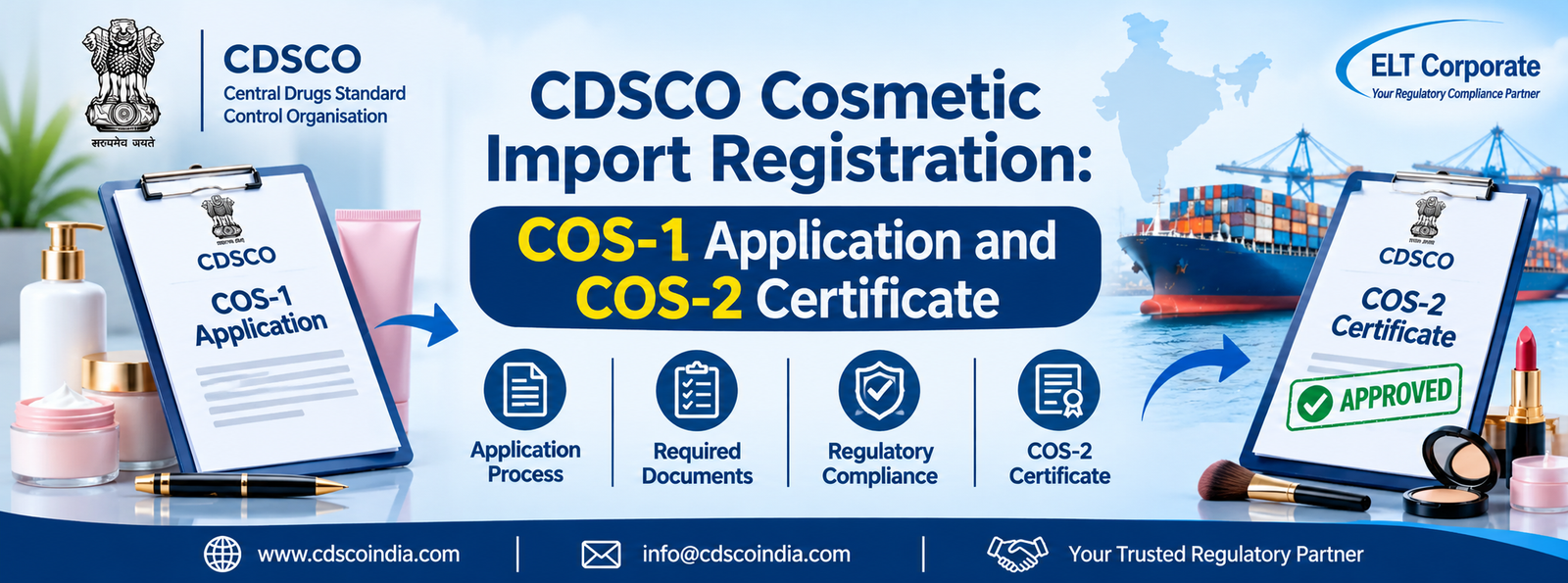
To import cosmetics legally, applicants generally need to submit an application in Form COS-1 and obtain a registration certificate in Form COS-2, subject to applicable requirements.
This guide explains the complete CDSCO Cosmetic Import Registration process in simple language, including application requirements, necessary documents, the difference between COS-1 and COS-2, and common mistakes to avoid.
What Is CDSCO Cosmetic Import Registration?
CDSCO Cosmetic Import Registration refers to the regulatory registration process applicable to importing cosmetics into India under the Cosmetics Rules, 2020.
It helps ensure that imported cosmetic products meet the applicable Indian quality, safety, labelling and regulatory requirements.
Cosmetic products may include:
- Skincare creams and lotions
- Face washes and cleansers
- Hair oils and shampoos
- Makeup and beauty products
- Perfumes and deodorants
- Sunscreen products
- Nail care products
- Other products falling within the definition of cosmetics
Businesses planning to import these products should first determine whether their products fall under the definition of cosmetics under Indian law and identify the applicable registration requirements.
What Are COS-1 and COS-2 Forms?
The COS-1 and COS-2 forms are important parts of the cosmetic import registration process in India. Both forms have different purposes.
1. COS-1 Application Form
COS-1 is the prescribed application form used for applying for registration of cosmetics intended to be imported into India.
The applicant provides relevant information about the importing business, manufacturer, manufacturing premises and cosmetic products. The application should contain accurate information and the supporting documents required under the applicable rules.
2. COS-2 Registration Certificate
COS-2 is the registration certificate issued by the licensing authority after the application is examined and the applicable requirements are fulfilled.
It serves as evidence of registration for the cosmetics covered by the certificate.
Submitting a COS-1 application does not automatically mean that registration has been granted. The applicant must obtain the applicable COS-2 certificate before proceeding with commercial imports.
Who Can Apply for CDSCO Cosmetic Import Registration?
Under the Cosmetics Rules, 2020, the following applicants can submit an application for importing cosmetics into India:
- Foreign Manufacturer: The manufacturer can apply directly for registration.
- Authorised Indian Agent: An Indian representative authorised by the foreign manufacturer can submit the application.
- Indian Importer: An importer in India can apply with the required manufacturer authorisation.
- Indian Subsidiary: An Indian subsidiary authorised by the manufacturer can also apply.
The manufacturer must provide the necessary authorisation and supporting documents as prescribed under the rules.
Documents Required for CDSCO Cosmetic Import Registration
Preparing the correct documents is an important part of the application process. Incomplete documents or differences in product information may lead to regulatory queries.
The following documents are generally required:
1. Manufacturer Authorisation Documents
- Authorisation letter or Power of Attorney from the foreign manufacturer.
- Details of the Indian authorised agent or importer.
- Manufacturer’s complete name and address.
- Manufacturing site details.
- Proper authentication of the authorisation document.
2. Product-Related Documents
- Complete list of cosmetic products.
- Product names and variants.
- Pack sizes of each product.
- Complete ingredient list with percentages.
- Product specifications.
- Testing methods and applicable quality standards.
- Proposed product labels.
- Package inserts, wherever applicable.
3. Manufacturing and Regulatory Documents
- Manufacturing licence or equivalent document from the country of origin, as applicable.
- Free Sale Certificate or other applicable regulatory evidence.
- Details of the manufacturing premises.
- Product categorisation information.
- Declaration and undertakings required under the applicable rules.
4. Importer-Related Documents
- Importer’s company registration details.
- Importer or authorised agent’s address proof.
- Covering letter.
- Required application declarations.
- Applicable registration fee payment receipt.
Step-by-Step Process for CDSCO Cosmetic Import Registration
The application process involves preparing product information, uploading documents and responding to regulatory queries.
Here is a simplified explanation of the process.
Step 1: Identify the Cosmetic Products
First, identify all the cosmetic products that you want to import into India.
Check the product category, ingredients, variants, pack sizes and manufacturing details. Make sure the products fall within the definition of cosmetics under the Drugs and Cosmetics Act, 1940.
Step 2: Appoint an Authorised Indian Agent
A foreign manufacturer can appoint an authorised agent or importer in India to handle the registration process.
The manufacturer must provide the appropriate authorisation document containing the required details.
Step 3: Prepare the Required Documents
Collect all the necessary product, manufacturing and company-related documents.
Check that product names, ingredients, manufacturing addresses and pack sizes are consistent across the application and supporting documents.
Step 4: Submit the COS-1 Application
The applicant must submit the application in Form COS-1 through the CDSCO online application system.
The applicant needs to enter the required details, upload supporting documents and complete the applicable payment process.
Step 5: CDSCO Application Review
After submission, the application is examined by the concerned CDSCO officials.
The authority reviews the submitted documents and verifies whether the application meets the applicable regulatory requirements.
If any information is missing or clarification is required, the applicant may receive regulatory queries.
Step 6: Respond to Regulatory Queries
If CDSCO raises any objection or requests additional information, the applicant should provide an appropriate response with the necessary supporting documents.
Timely and accurate responses can help avoid unnecessary delays.
Step 7: Obtain the COS-2 Certificate
Once the application is found satisfactory and approved by the Central Licensing Authority, the Import Registration Certificate in Form COS-2 is granted.
The applicant should verify the registered products, manufacturing premises and other particulars mentioned in the certificate before proceeding with imports.
Difference Between COS-1 and COS-2
Many businesses get confused between the COS-1 application and the COS-2 certificate. Both forms are connected with cosmetic import registration, but their purposes are different.
| Basis | COS-1 | COS-2 |
| Meaning | Application form | Import Registration Certificate |
| Purpose | Used to apply for registration | Issued after approval |
| Issuing authority | Submitted to CDSCO | Granted by the Central Licensing Authority |
| Applicant’s role | Provides product and manufacturer details | Receives registration approval |
| Importance | Starts the registration process | Establishes registration for the covered cosmetics |
In simple terms, COS-1 is the application, whereas COS-2 is the certificate granted after successful approval.
Important Rules for Importing Cosmetics into India
Businesses must follow the relevant provisions of the Cosmetics Rules, 2020, before importing cosmetic products.
Some important regulatory requirements include:
- Product Registration: Cosmetics must be registered before import into India, as required under Rule 12.
- Manufacturing Site Registration: The manufacturing premises must be covered by the applicable registration.
- Product Safety: Products must comply with applicable quality and safety standards under Rule 39.
- Correct Labelling: Imported cosmetic products must follow the applicable labelling requirements.
- Accurate Product Information: Product ingredients, variants and pack sizes should match the approved registration particulars.
- New Cosmetics: Products classified as new cosmetics may require prior permission in Form COS-3 before import registration.
Businesses should also ensure that their product claims are not false or misleading under the applicable rules.
Common Mistakes to Avoid During COS-1 Application
A small documentation mistake can create problems during the application review. Businesses should pay attention to the following points:
- Incorrect Manufacturer Details: Ensure that the manufacturer’s name and address match the supporting documents.
- Incomplete Product Information: Provide complete details of ingredients, variants and pack sizes.
- Improper Authorisation: Submit a properly authenticated manufacturer authorisation.
- Incorrect Product Labels: Check that proposed labels comply with Indian cosmetic labelling requirements.
- Missing Supporting Documents: Review the official checklist before submission.
- Incorrect Product Classification: Confirm that the product is classified correctly under the applicable regulatory framework.
- Ignoring CDSCO Queries: Respond to regulatory observations with accurate information and supporting documents.
Avoiding these mistakes can make the application review process more organised and reduce the possibility of repeated queries.
How Long Does CDSCO Cosmetic Import Registration Take?
The time required for CDSCO Cosmetic Import Registration depends on the completeness of the application, the number of products, the manufacturing details and the regulatory review.
Under Rule 13 of the Cosmetics Rules, 2020, the Central Licensing Authority may grant or reject the application, with reasons recorded in writing, within six months from the date of application.
However, additional document requirements, regulatory queries or product-related clarifications may affect the overall timeline.
Applicants should therefore prepare complete documentation before submitting the COS-1 application.
Why Is CDSCO Cosmetic Import Registration Important for Importers?
Obtaining CDSCO Cosmetic Import Registration is important for businesses that want to import and sell cosmetic products in the Indian market legally.
It helps businesses:
- Meet the applicable Indian cosmetic import regulations.
- Establish regulatory compliance for imported products.
- Maintain proper manufacturer and product documentation.
- Reduce the risk of import-related regulatory issues.
- Build confidence among distributors and business partners.
- Establish a more organised process for introducing international cosmetic brands in India.
A proper understanding of the registration requirements can help importers plan their business activities more effectively.
How ELT Corporate Helps with CDSCO Cosmetic Import Registration
ELT Corporate provides regulatory assistance to businesses planning to import cosmetic products into India. Our team helps applicants understand the applicable requirements and prepare the necessary documentation for the registration process.
Our support includes:
- Guidance on COS-1 application preparation.
- Assistance with manufacturer authorisation documents.
- Review of cosmetic product information.
- Assistance with document compilation.
- Guidance on product labelling requirements.
- Support in responding to CDSCO regulatory queries.
- Assistance with the COS-2 registration process.
Whether you are a foreign cosmetic manufacturer, an Indian importer or an authorised agent, ELT Corporate can help you understand the regulatory steps involved in cosmetic imports.
Contact ELT Corporate for professional guidance on cosmetic import registration and regulatory compliance in India.
Conclusion
Importing cosmetic products into India requires proper regulatory planning and compliance with the Cosmetics Rules, 2020. Understanding the COS-1 application and COS-2 certificate is essential for manufacturers, importers and authorised Indian agents.
The CDSCO Cosmetic Import Registration process involves product identification, manufacturer authorisation, document preparation, online application submission and regulatory review. Businesses should ensure that all product details and supporting documents are accurate before applying.
With proper preparation and regulatory guidance, businesses can make the registration process more organised and avoid common documentation mistakes.
Frequently Asked Questions
CDSCO Cosmetic Import Registration is the regulatory process for registering cosmetic products intended to be imported into India under the Cosmetics Rules, 2020.
Form COS-1 is the application form submitted to CDSCO to obtain an Import Registration Certificate for cosmetic products.
COS-2 is the Import Registration Certificate granted by the Central Licensing Authority after examining and approving the application.
Yes. Under Rule 12 of the Cosmetics Rules, 2020, cosmetic products must be registered before they are imported into India.
A foreign manufacturer, its authorised Indian agent, an importer in India or an Indian subsidiary authorised by the manufacturer can apply.
Common documents include manufacturer authorisation, product details, ingredient lists, manufacturing information, proposed labels, applicable regulatory certificates and importer details.
Rule 13 provides for the Central Licensing Authority to grant or reject an application within six months from the application date. Actual processing may depend on documentation and regulatory queries.
Yes. Rule 13(4) allows a single application and certificate for one or more cosmetics manufactured by the same manufacturer, subject to the applicable manufacturing premises conditions.