Introduction
Medical devices are an important part of modern healthcare. From thermometers and blood pressure monitors to surgical instruments, implants, and diagnostic equipment, these products help doctors diagnose, treat, and monitor different health conditions.
However, before businesses can manufacture, import, or sell medical devices in India, they must understand and comply with the applicable regulatory requirements.
This is where the CDSCO plays a key role.CDSCO is India’s central regulatory authority responsible for regulating the quality, safety, and performance of medical devices under applicable Indian laws. It operates under the Directorate General of Health Services, Ministry of Health and Family Welfare, Government of India.
For medical device manufacturers, importers, distributors, and healthcare businesses, understanding CDSCO is essential for entering and operating in the Indian medical device market.
In this guide, ELT Corporate explains what CDSCO is, its major functions, its role in medical device regulation, and how businesses can meet the applicable compliance requirements.
What is CDSCO?
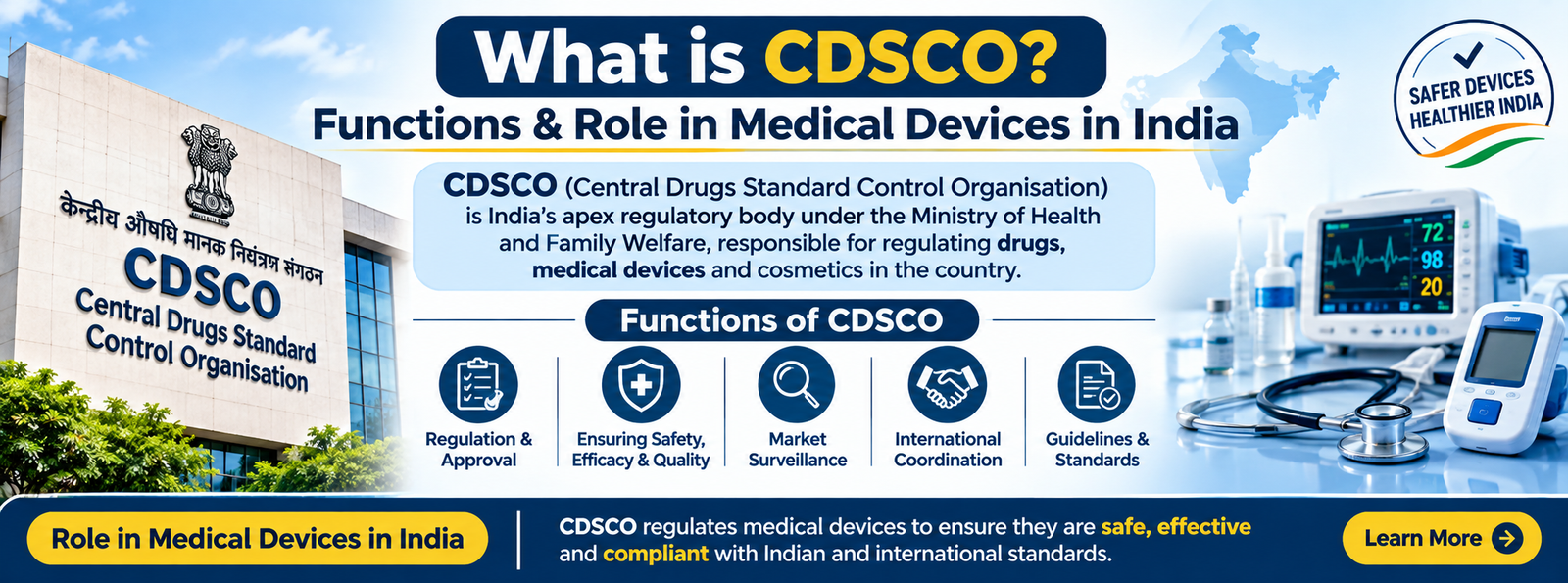
CDSCO stands for Central Drugs Standard Control Organisation. It is the central government authority responsible for regulating specified drugs, medical devices, and related healthcare products in India.
For medical devices, CDSCO works under the Drugs and Cosmetics Act, 1940, and the Medical Devices Rules, 2017.
The organisation helps ensure that medical devices available in India meet the applicable requirements for safety, quality, and performance.
Its responsibilities include regulating medical device imports, granting specified manufacturing licenses, overseeing clinical investigations, and coordinating with State Licensing Authorities.
Quick Overview of CDSCO
| Particular | Details |
| Full Form | Central Drugs Standard Control Organisation |
| Regulatory Authority | Government of India |
| Ministry | Ministry of Health and Family Welfare |
| Headquarters | New Delhi, India |
| Main Medical Device Law | Medical Devices Rules, 2017 |
| Main Objective | Safety, quality and performance of medical devices |
| Regulated Businesses | Manufacturers, importers and other relevant stakeholders |
What is the Role of CDSCO in Medical Devices?
The primary role of CDSCO in medical devices is to ensure that products entering the Indian market comply with the applicable regulatory requirements.
Medical devices are regulated according to their intended purpose and risk level. This means that a simple medical device may have different regulatory requirements from a high-risk implantable or life-supporting device.
The CDSCO regulatory framework helps protect patients while allowing businesses to manufacture, import and supply medical devices through a regulated process.
7 Key Functions of CDSCO in Medical Device Regulation
1. Medical Device Import Regulation
One of the important functions of CDSCO is regulating the import of medical devices into India.
Businesses importing medical devices must determine whether their products require an import license or other regulatory approval under the applicable rules.
The regulatory process may involve submitting product information, manufacturing details, quality documents and other required supporting records.
Why is this important?
It helps ensure that medical devices imported into India meet the applicable safety, quality and performance requirements.
2. Medical Device Manufacturing Licensing
CDSCO is responsible for granting manufacturing licenses for specified categories of medical devices.
Under the Medical Devices Rules, 2017:
- The Central Licensing Authority generally handles manufacturing licenses for Class C and Class D medical devices.
- State Licensing Authorities generally handle manufacturing licenses for Class A and Class B medical devices, subject to applicable requirements and exemptions.
Manufacturers need to identify the correct license category and licensing authority before starting commercial manufacturing.
3. Medical Device Risk Classification
Medical devices are classified into four categories according to their risk level.
| Class | Risk Level | Examples |
| Class A | Low Risk | Certain non-invasive devices |
| Class B | Low-Moderate Risk | Certain diagnostic and monitoring devices |
| Class C | Moderate-High Risk | Certain implantable and therapeutic devices |
| Class D | High Risk | Certain life-supporting and high-risk implantable devices |
The classification depends on the device’s intended use and applicable classification rules. A product should not be classified only by its name or appearance.
4. Clinical Investigation and Medical Device Approval
CDSCO oversees specified clinical investigations and approval-related activities for medical devices. For certain new medical devices, clinical investigation or additional evidence may be required before regulatory approval can be granted.
The purpose is to evaluate whether the device performs as intended and meets the applicable safety and performance requirements.
This is particularly important for innovative medical technologies and devices without an appropriate predicate device.
5. Medical Device Quality and Safety Monitoring
CDSCO plays an important role in maintaining the quality and safety of medical devices available in India.
Regulatory requirements may include quality management systems, technical documentation, testing, and compliance with license conditions.
Medical device license holders also need to establish appropriate post-market surveillance systems to identify, document, and report relevant adverse events.
6. Coordination with State Licensing Authorities
Medical device regulation in India involves both central and state regulatory authorities.
CDSCO performs central-level regulatory functions and coordinates with State Licensing Authorities to support consistent implementation of applicable rules.
This division of responsibilities helps businesses understand which authority is responsible for their particular manufacturing, sale or distribution activity.
7. Medical Device Testing and Regulatory Standards
CDSCO also oversees specified medical device testing and evaluation activities through designated laboratories and registered testing facilities.
Testing and evaluation help determine whether a device meets the applicable technical, safety, and performance requirements.
The organisation also publishes regulatory rules, guidance documents, notifications, and other information to help medical device businesses understand their compliance responsibilities.
Why is CDSCO Important for Medical Device Businesses in India?
Understanding CDSCO is important for businesses planning to enter or expand in the Indian medical device market.
Here are some key reasons:
- Regulatory compliance: Helps businesses understand the approvals and licenses applicable to their products.
- Patient safety: Supports the availability of medical devices that meet required safety and quality standards.
- Market access: Helps manufacturers and importers follow the necessary regulatory process before marketing devices.
- Product quality: Promotes compliance with applicable quality management and technical requirements.
- Business continuity: Helps reduce the risk of regulatory delays, non-compliance, and disruptions.
- Legal compliance: Supports businesses in meeting their obligations under applicable medical device regulations.
Which Medical Devices are Regulated by CDSCO?
Medical devices regulated under India’s framework include products intended for diagnosis, prevention, monitoring, treatment, or alleviation of diseases, injuries, and disabilities.
The applicable regulatory requirements depend on the device’s intended purpose, classification, and other relevant factors.
CDSCO Registration and Licensing Process for Medical Devices
Businesses should understand the regulatory process before manufacturing or importing medical devices into India.
Although the exact process varies by product and activity, the following steps provide a general overview.
- Identify the medical device
Determine the product’s intended use, specifications, and regulatory status. - Check the risk classification
Identify whether the device falls under Class A, B, C, or D. - Identify the applicable license
Determine whether the activity requires an import license, manufacturing license, test license, or another approval. - Prepare the required documents
Collect product details, manufacturing information, quality documents, test reports, and other applicable records. - Submit the application
Apply to the relevant Central or State Licensing Authority through the applicable regulatory system. - Respond to regulatory queries
Provide clarification or additional documents if requested by the authority. - Maintain ongoing compliance
Follow license conditions, quality requirements, reporting obligations, and applicable post-market surveillance requirements.
The exact application forms, documents, fees, and timelines depend on the device category and regulatory activity. Businesses should verify the current requirements before applying.
Documents Required for CDSCO Medical Device Registration
The documents required for medical device registration or licensing may vary depending on whether the applicant is a manufacturer, importer or another regulated business.
Common documents may include:
| Document | Purpose |
| Device description | Identifies the medical device and its intended use |
| Product specifications | Provides technical information |
| Manufacturing details | Identifies the manufacturing facility and process |
| Quality management documents | Demonstrates applicable quality system compliance |
| Test reports | Supports safety and performance requirements |
| Free Sale Certificate | May be required for specified import applications |
| Authorisation documents | Establishes the relationship between relevant parties |
| Label and packaging details | Supports compliance with applicable labelling requirements |
| Application forms and fee details | Required for the relevant regulatory submission |
This is a general checklist. Not every document applies to every medical device or application.
Common CDSCO Compliance Mistakes to Avoid
Medical device businesses may face regulatory delays or compliance issues when they:
- Select the wrong medical device risk classification.
- Apply to the wrong licensing authority.
- Submit incomplete or inconsistent product documents.
- Overlook applicable testing or quality requirements.
- Use incorrect product labelling or packaging information.
- Fail to respond to regulatory queries on time.
- Ignore post-market surveillance and license conditions.
Proper regulatory planning can help businesses reduce these risks and prepare more complete applications.
How ELT Corporate Helps with CDSCO Medical Device Registration
ELT Corporate provides regulatory compliance assistance to medical device manufacturers, importers, and other businesses seeking to understand and complete their applicable medical device registration and licensing requirements in India.
1. Medical Device Classification Assistance
We help businesses identify the applicable medical device category based on the product’s intended use and relevant classification rules.
2. CDSCO Registration and Licensing Support
We assist in identifying the appropriate regulatory pathway and preparing applications for applicable medical device registration and licensing requirements.
3. Documentation Preparation
Our team helps organise product information, manufacturing documents, technical details, and other supporting records required for the relevant application.
4. Import and Manufacturing License Assistance
We support importers and manufacturers in understanding the applicable regulatory requirements for their business activities.
5. Regulatory Query Support
We assist businesses in preparing responses and supporting documents for regulatory queries, where required.
6. Ongoing Compliance Guidance
We help businesses understand applicable license conditions, documentation responsibilities, and post-approval compliance requirements.
Planning to register or import a medical device in India? Contact ELT Corporate for assistance in understanding the applicable CDSCO regulatory requirements for your product.
Frequently Asked Questions
CDSCO stands for Central Drugs Standard Control Organisation. It is India’s central regulatory authority responsible for regulating the quality, safety, and performance of medical devices and specified healthcare products.
The main function of CDSCO in medical devices is to regulate applicable import and manufacturing activities, oversee specified clinical investigations, establish regulatory requirements, and support the safety and quality of medical devices available in India.
Medical devices in India are regulated under the Drugs and Cosmetics Act, 1940, and the Medical Devices Rules, 2017, along with applicable amendments and notifications.
The applicable registration or licensing requirements depend on the device, its classification, and the proposed activity. Businesses should verify the current regulatory requirements before manufacturing, importing, or marketing a medical device.
Medical devices are classified into four risk categories:
- Class A – Low Risk
- Class B – Low-Moderate Risk
- Class C – Moderate-High Risk
- Class D – High Risk
The classification depends on the device’s intended purpose and applicable classification rules.
The Central Licensing Authority generally grants manufacturing licenses for Class C and Class D medical devices. State Licensing Authorities generally handle Class A and Class B manufacturing licenses, subject to applicable requirements and exemptions.
Common documents may include product specifications, device descriptions, manufacturing information, quality management documents, test reports, labelling details, and applicable authorisation documents. The exact checklist depends on the regulatory application.
ELT Corporate assists medical device businesses with regulatory pathway identification, risk classification guidance, documentation preparation, applicable registration and licensing applications, and regulatory query support.